UX Case Study · Automating Onboarding for Unbxd
UX Case Study: Automating Onboarding for Unbxd

Automating Onboarding for an AI-Powered Commerce Platform
Unbxd is an e-commerce product discovery platform that applies artificial intelligence and advanced data sciences to connect shoppers to the products they are most likely to buy. Onboarding is a critical moment in any product experience — especially in complex, AI-driven platforms where value is not immediately visible.
At Unbxd, despite offering powerful product discovery capabilities, users struggled to get started and realise value early. This project focused on redefining the onboarding experience to make it more guided, intuitive, and outcome-driven — ultimately improving activation, engagement, and retention.
Netcoreunbxd.com- Stakeholder discussions
- Competitive benchmarking
- User interviews
- User feedback analysis
- Personas & user journeys
- Problem definition
- Brainstorming sessions
- Design strategy
- Feature identification
- Information architecture
- Wireframes & prototypes
- Visual design
- Usability testing
- Analytics & iteration
Research
The research phase combined stakeholder insights and industry best practices to understand onboarding challenges, define user needs, and identify opportunities to improve activation and conversion.
The research phase combined stakeholder insights and industry best practices to understand onboarding challenges, define user needs, and identify opportunities to improve activation and conversion.
The primary users of the platform were merchandisers, catalogue managers, and marketing managers, who are responsible for configuring search, optimizing product discovery, and driving conversions, often without deep technical expertise.
- Users struggled to understand how to get started and often relied on external support for setup
- The existing onboarding lacked structure, leading to confusion and delayed time-to-value
- Heavy dependency on custom implementations limited scalability and slowed customer adoption
- Users needed clearer guidance to experience the product's core value early in the journey
Research also highlighted that onboarding should not end after initial activation, but should evolve into a continuous engagement system.
In SaaS ecosystems, ongoing onboarding plays a key role in:
- Driving feature adoption
- Encouraging upgrades and expansion
- Improving retention and long-term customer value
This aligns with the customer engagement funnel, where continuous guidance and education help transform users into long-term advocates.
Analysis revealed that 27% of users dropped off during the configuration stage, making onboarding a critical point of churn, where users struggled to complete setup and failed to experience early value. This highlighted a clear opportunity to improve retention by introducing a more structured, guided onboarding experience that not only reduces friction and accelerates time-to-value but also enables continuous optimization through user behaviour insights while aligning the experience more closely with user goals.


Strategy
The strategy focused on guiding users through structured onboarding flows, delivering value early in the experience, and reducing decision-making effort through defaults and intelligent recommendations.
Ideate
Based on research insights, the ideation phase focused on exploring ways to transition from a service-led model to a guided, semi-self-serve onboarding experience, generating solutions that simplify complex setup workflows through step-by-step guidance, contextual support, and pre-configured defaults, while ensuring users can quickly understand the product, make confident decisions, and reach their first value moment with minimal effort.


Design
The design phase focused on translating insights into a scalable, guided onboarding experience by structuring the journey into clear, step-by-step flows that reduce complexity and cognitive load, while enabling users to confidently complete setup and reach value faster through progressive disclosure, contextual guidance, and pre-configured defaults, supported by intuitive information architecture, wireframes, and high-fidelity designs aligned with both user needs and business goals.

It's all about automation
Faster onboarding, flash feed-indexing, automated relevance setup, and self-optimizing algorithms take care of the search experience for the entire customer lifetime.

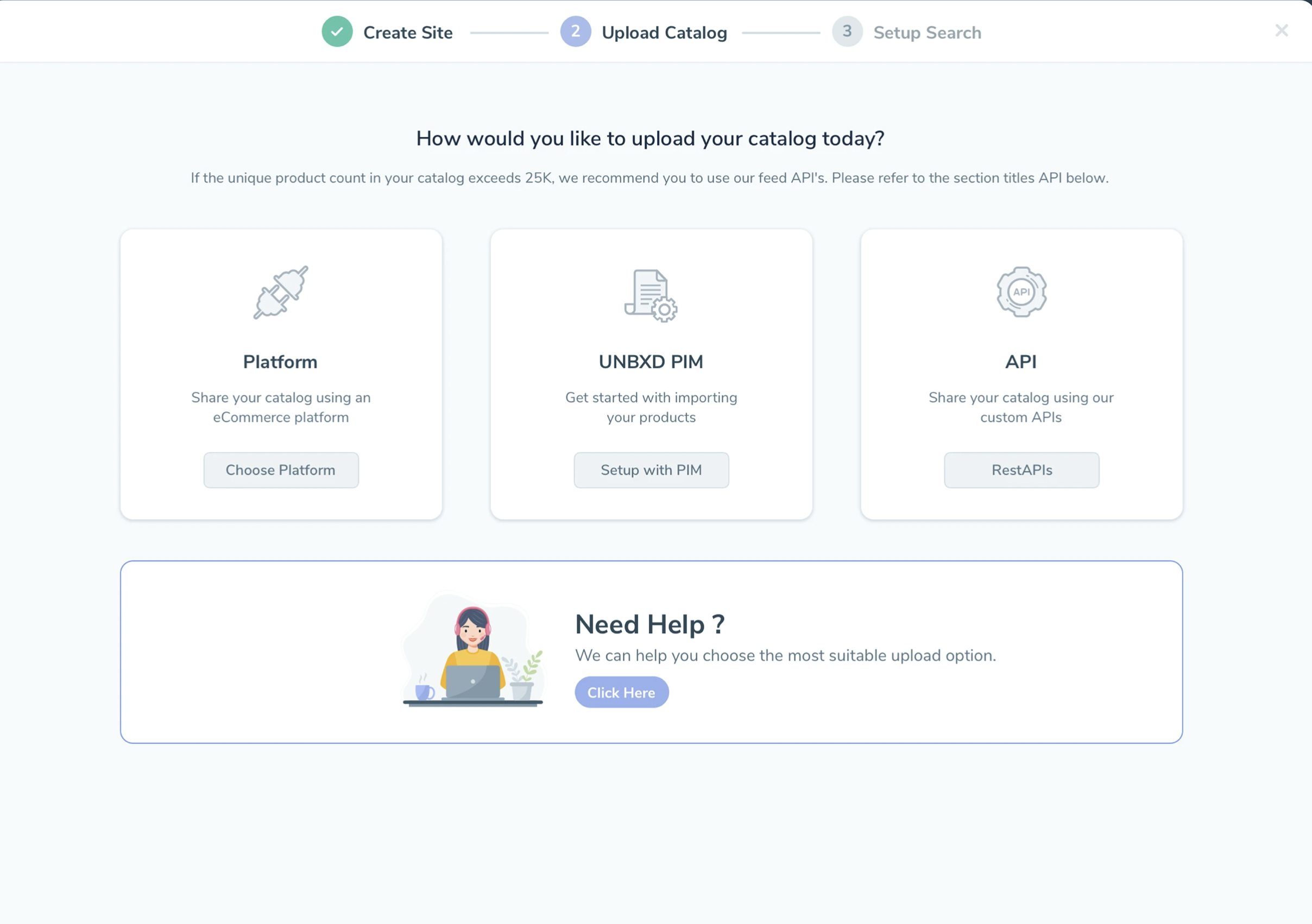
Faster Onboarding Using AI Powered Search

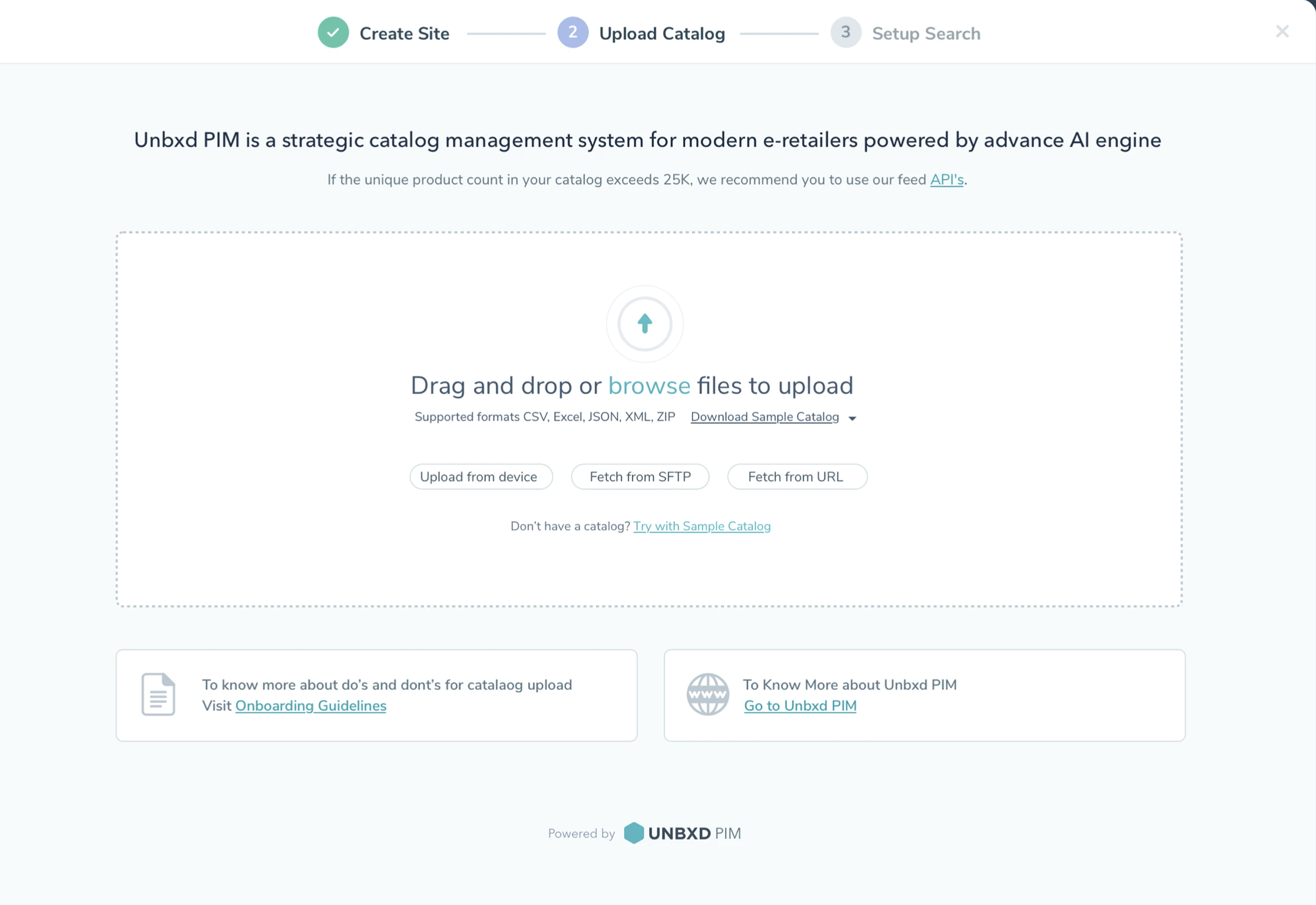
Superfast Catalog Upload
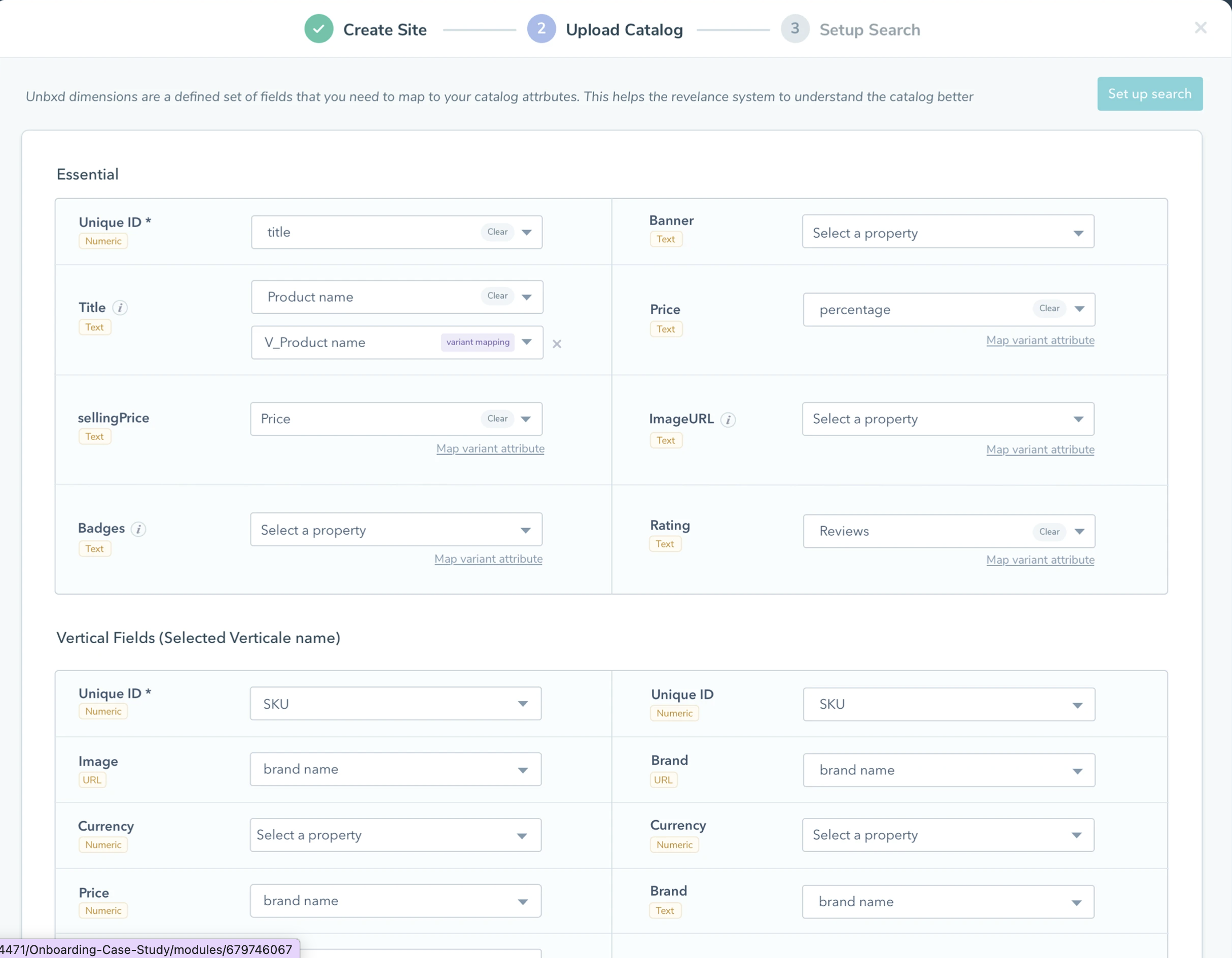
AI-Powered Site Search Setup for best relevance
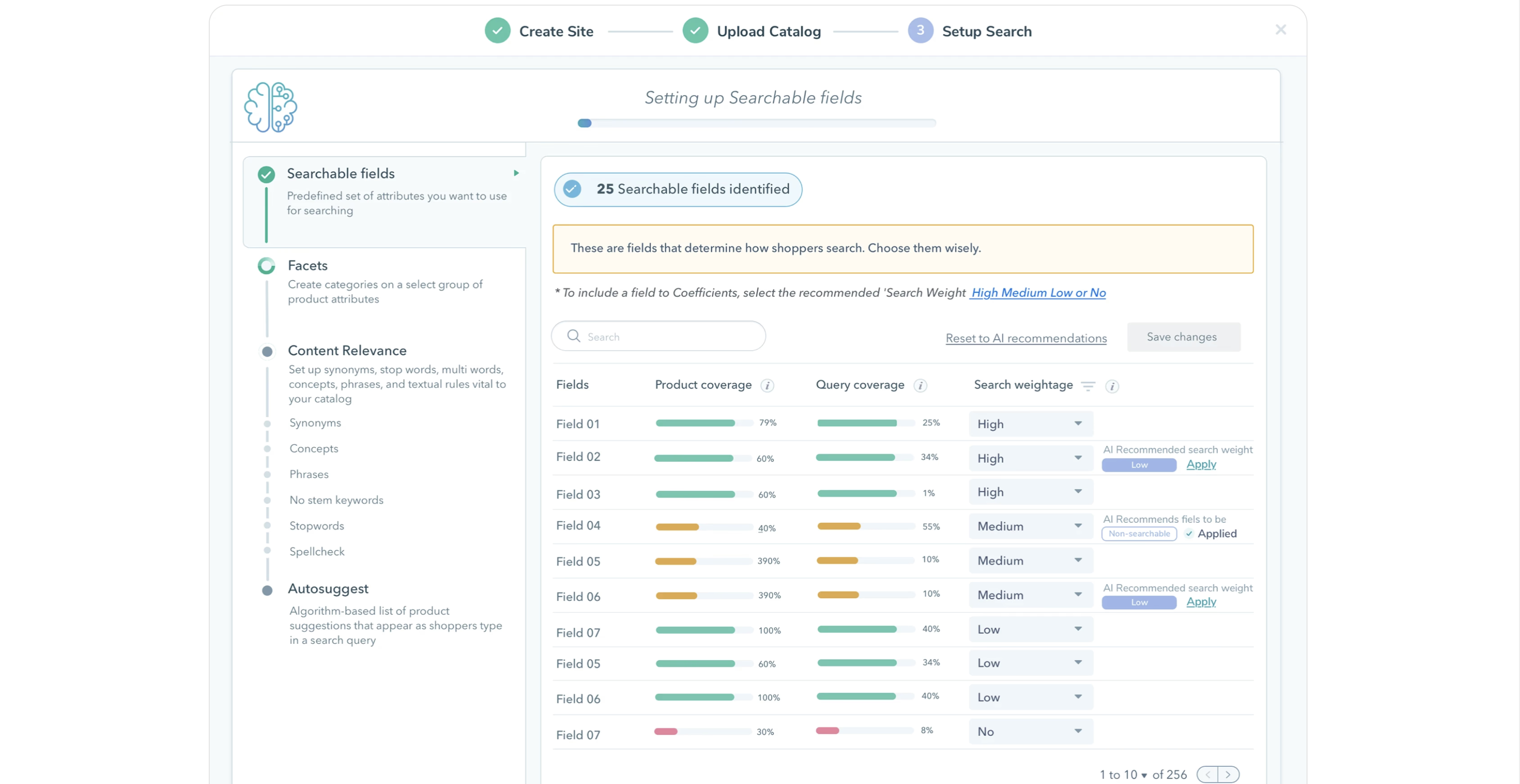
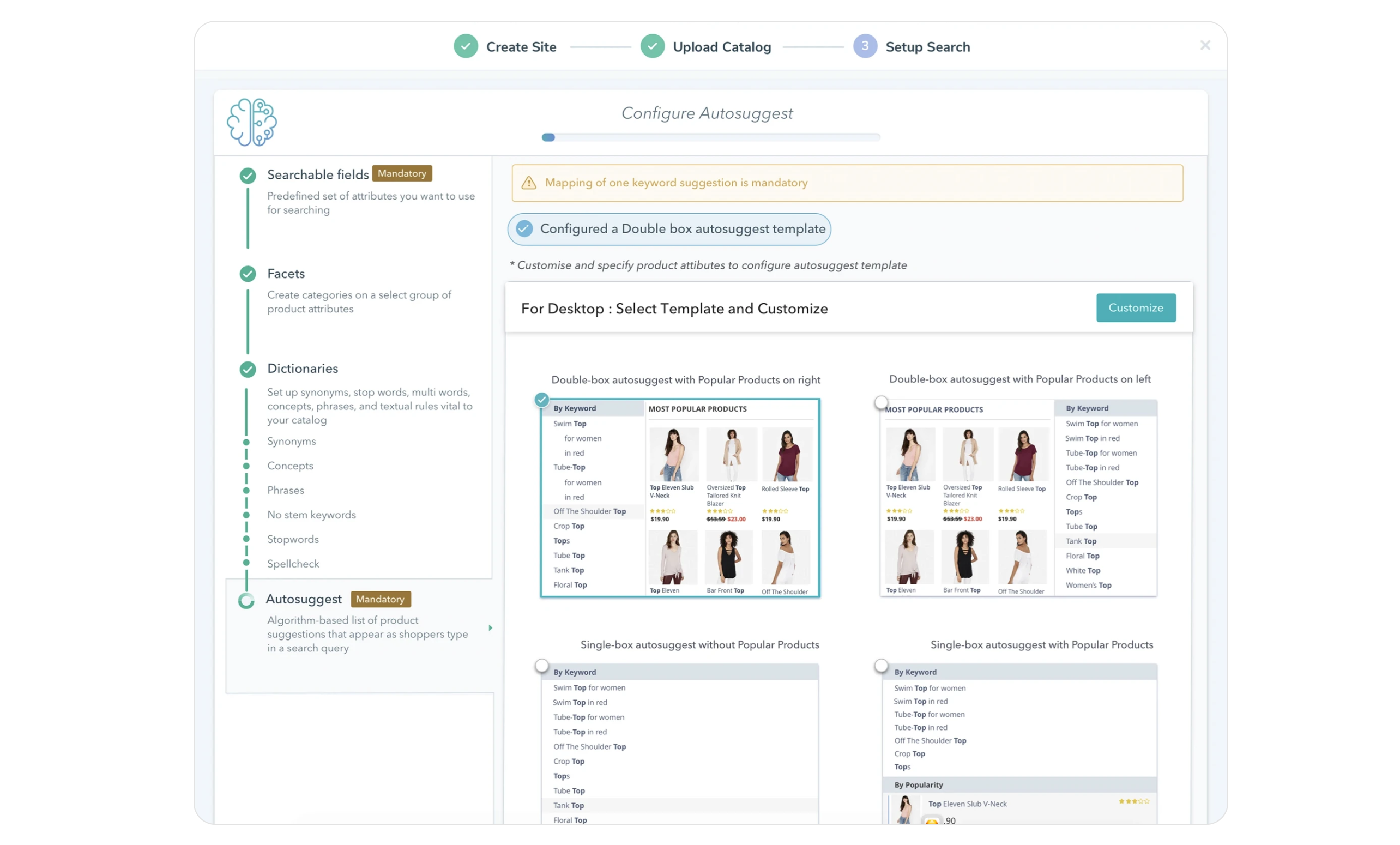
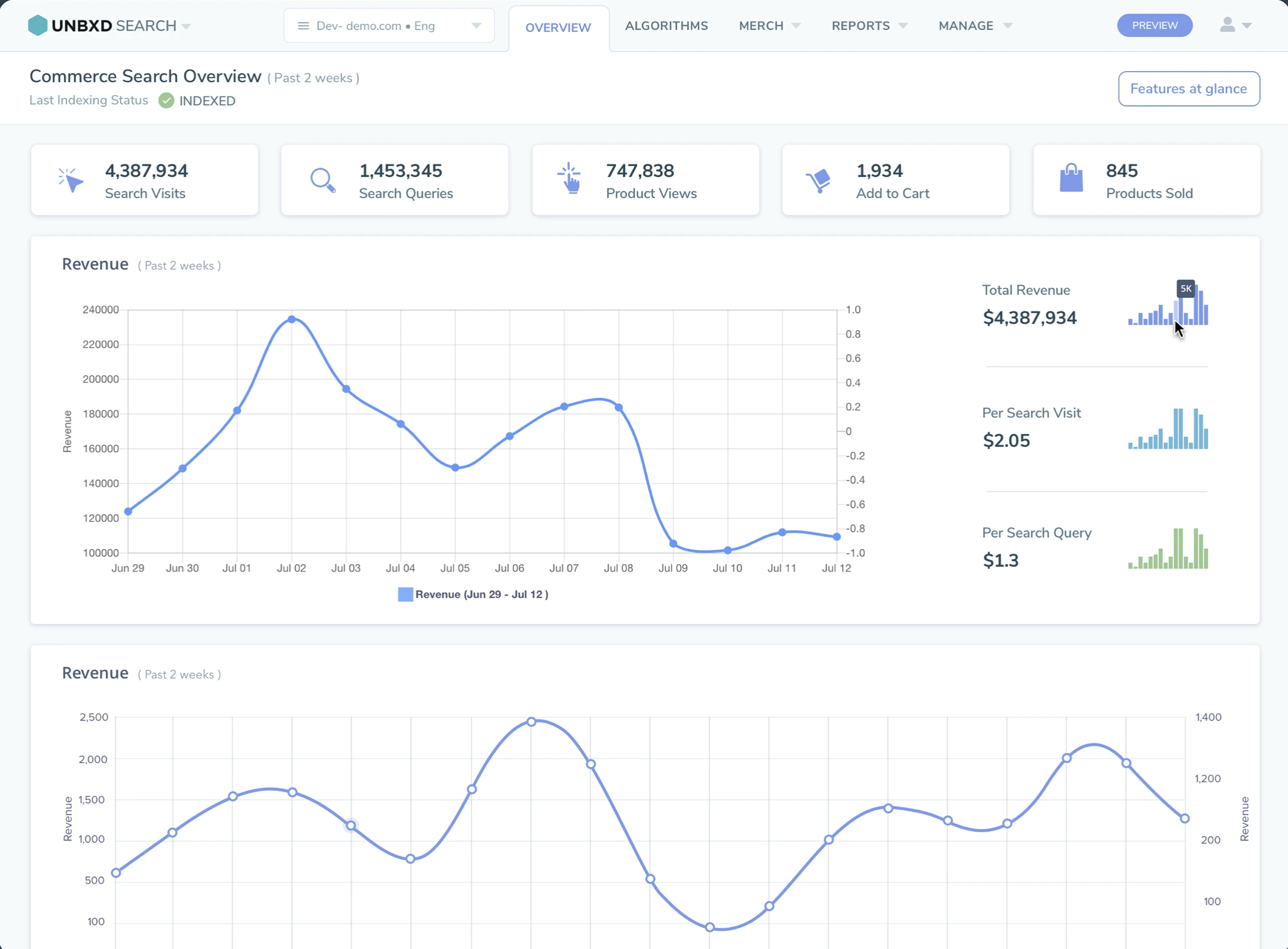
The Search APIs with
Contextual Relevence are now ready now!
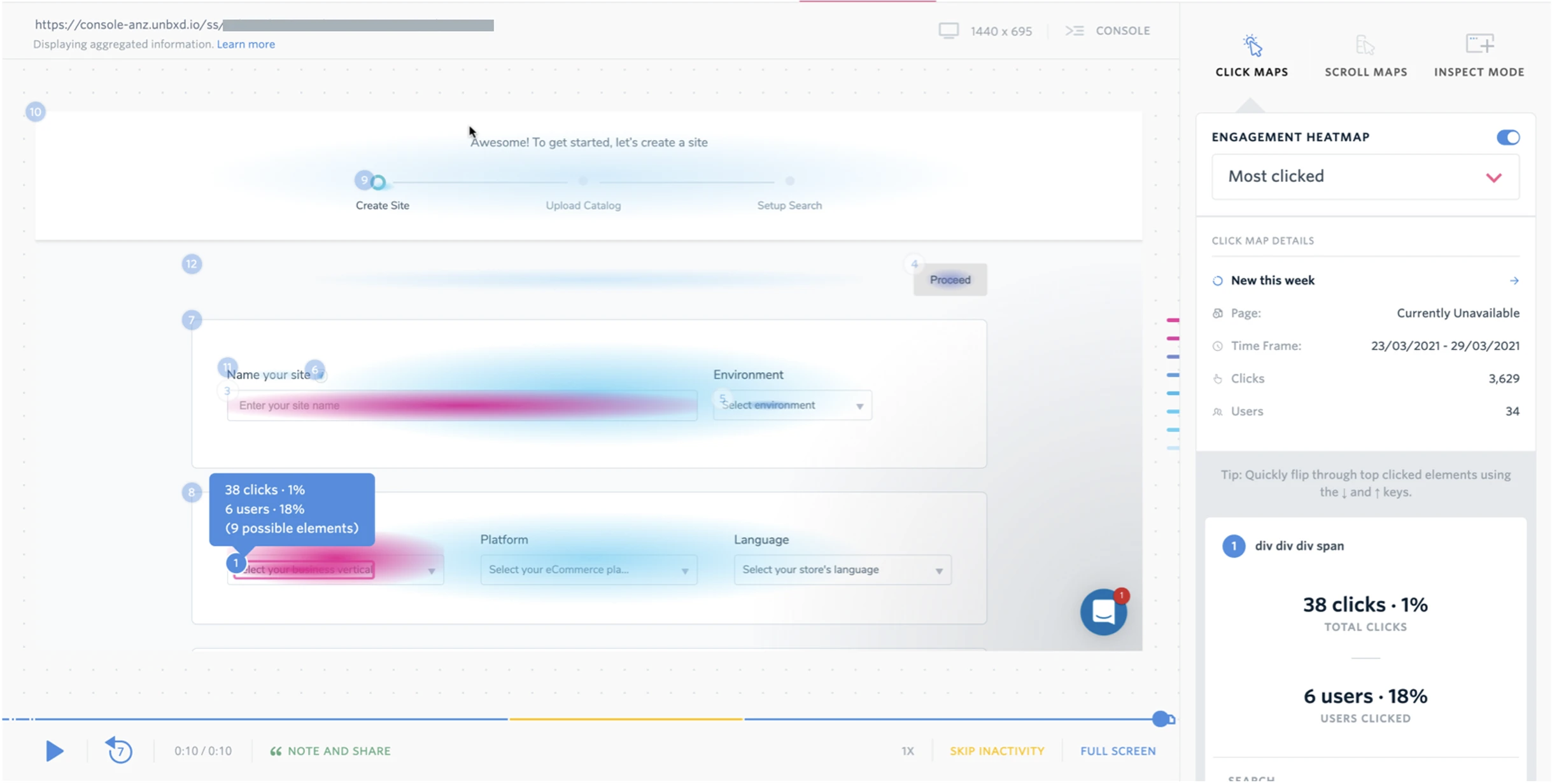
Validation was a critical step to ensure the designed experience effectively met user needs and improved onboarding outcomes, enabling the team to assess whether the solution worked in real-world scenarios. Continuous analysis of user behaviour was conducted using tools such as FullStory and Mixpanel to evaluate usability, identify friction points, and measure the success of the onboarding experience.
This ongoing validation approach allowed the team to track key metrics such as drop-off rates, task completion, and time-to-value, while uncovering opportunities for iterative improvements, ensuring the final design not only functioned effectively but also delivered measurable impact on user activation and retention.